

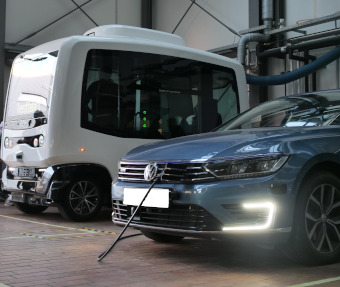
 The aim of the project is to establish an autonomous shuttle bus service. The vehicle will be able to pick up and drop off passengers fully autonomously at various stops along a designated route. The operation is continuously monitored and evaluated by a Safety Control Center. In the event of an unforeseen incident, the Safety Control Center can send control signals to the vehicle to resolve the situation.
Our project develops new approaches for automated driving in clearly defined areas and on recurring routes. The goal is to create algorithms that are not only powerful but also transferable to different environments. Together with our partners, we research and test cloud-connected methods that are practically validated in multiple test areas.
At the core are modern AI techniques such as trajectory optimization, deep learning, model predictive control, and sensor fusion. In addition, we investigate how mobile communication via 5G and satellites, V2X technologies, prediction algorithms, and remote-control concepts can make road traffic safer and more efficient.

 Developing a system to protect honey bees from varroa mites.
 Sensor data from bee hive is collected and analysed.
We have 95 guests and no members online